The following is a concept map and explanation that I completed based on “Jesus and the Disinherited” by Howard Thurman.

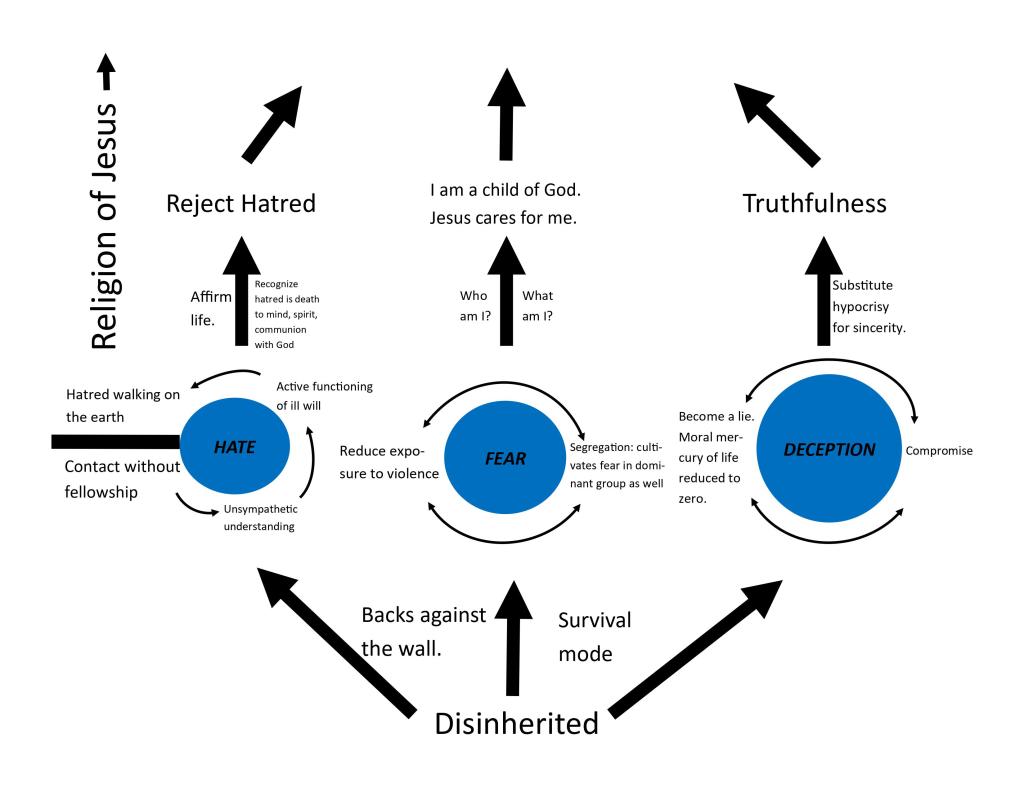
When the disinherited have their backs against the wall they use fear, hate, and deception (hounds of hell) as tools to survive. The religion of Jesus brings them out of those hounds of hell and into a common sense of mutual worth and value, into the ethic of love, and living out the “high destiny of a son of God”. (99)
It all begins with the disinherited, backs against the wall, fighting for survival. I represent this by starting the map with the disinherited and the ideas moving outward from there. Fear, hate, and deception flow from that initial starting point.
I depicted the three fear, hate, deception, and love as circles because they are the four main concepts in the book. The hounds of hell are matching blue and black lettering (death and darkness). Love is red like the classic color of a heart, with white letters (life and light).
Fear for the disinherited is born out of their exposure to violence. Not just any kind of violence, but specifically the uncontested kind. The powerful using their dominance to instill fear into the weak. (27) I placed this concept in a revolving circle around fear to show its interconnectedness with segregation in the use of fear. This exposure to violence is referred to by Thurman as a “war of nerves” (29). It is out of this war of nerves that the oppressed use fear to protect from their exposure to violence. This is done by training their bodies to behave in such a way as to prevent this violence. It becomes learned and is then imprinted onto children as well. (30) Segregation is useful for this purpose because it allows the dominant group to move about freely and restricts the oppressed group from movement. They are fixed in place, frozen by fear, maintaining the segregation. This also produces fear in the dominant group, as they begin to worry that the oppressed will harm them if not kept contained. (33-34)
Deception produces two options that worsen or uphold the oppressed condition. The first is to become a lie. This is to continuously deceive the dominant group, such that there is no truth. This is detrimental to the disinherited, as their “moral mercury of life is reduced to zero”. (55) The second is to compromise. This is to accept some losses of freedom and choose the battles of deception. In this view, to not be killed is the great end that justifies the compromising means. (55)
Hate is the last of the tools of the disinherited. I depicted this as a circle with beginning and end; the journey of how one gets to hate. Beginning with contact without fellowship, the lived reality of which is segregation. This moves to unsympathetic understanding, meaning the oppressors claim understanding only within the confines of their rules and status quo. This develops into active functioning of ill will, wherein hate begins to manifest itself. This finally culminates when hate inhabits the actions of oppressed and oppressor. (65-68)
In each case I have depicted upward arrows for the movement out of the hounds of hell to the religion of Jesus (shown on the left as beginning when coming out of the hounds of hell and encompassing all of the remaining journey). The journey out of deception is truthfulness, out of fear is self-realization (Who am I? What am I?), and out of hate is rejection of hate. These all converge in the common sharing of a sense of mutual worth and value, as Thurman states this is the first step toward love. (88) Out of this common sense of mutual worth and value is love of enemy, the central ethic of the religion of Jesus. Around love are the three types of enemy to be loved. The final words of his book are what I depict as the ultimate end and goal of his work: all people, strong and weak, oppressed and oppressor, inherited and disinherited, living out the high destiny of a son of God.
 justin is reading